


Leno’s Law in California: What Classic Honda Owners Need to Know
Legal Disclaimer: This article is for informational purposes only and is not a substitute for legal advice. Laws and eligibility requirements may change. Consult the California Bureau of Automotive Repair (BAR) for the latest regulations and exemption requirements.
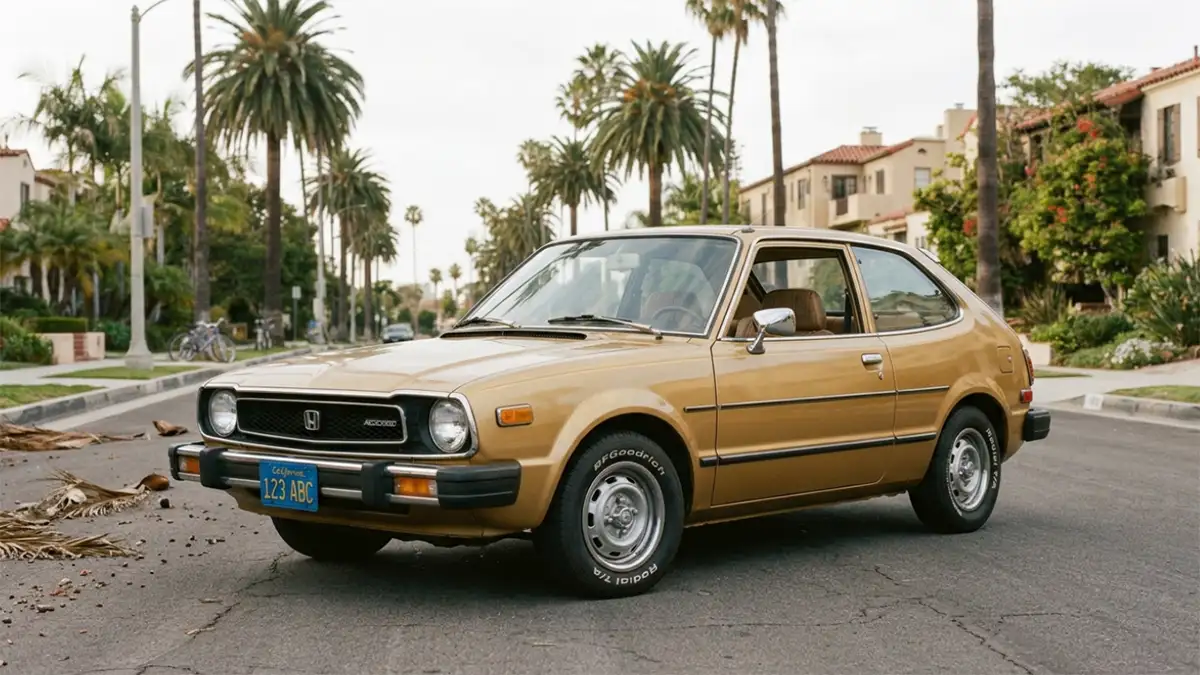
Quick Answer: Leno’s Law in California creates a new Smog Check exemption for qualifying collector vehicles from model years 1976 through 1985. The first group, 1976 through 1980 models, can begin qualifying in 2028. Later model years are added one at a time through 2033. The exemption applies to collector vehicles, not cars used for everyday transportation.
What Is Leno’s Law in California?
Leno’s Law, officially Senate Bill 1392, changes California’s Smog Check rules for certain classic and collector vehicles.
The legislation gets its name from Jay Leno, the former Tonight Show host and longtime automotive enthusiast who advocated for expanding California’s classic car exemptions. In a fitting tribute to his involvement, Governor Gavin Newsom signed the bill at Jay Leno’s Garage in Burbank on September 16, 2026.
Previously, California generally required gasoline vehicles from 1976 and newer to remain in the Smog Check program. California’s Leno’s Law creates a limited exemption for qualifying collector cars from 1976 through 1985.
The key word is collector. The law is designed for vehicles maintained primarily for shows, exhibitions, parades, and charitable events, rather than an older Civic or Accord someone depends on for daily transportation.
When Does Leno’s Law California Take Effect?
Leno’s Law effective date starts with the oldest eligible model years and expands from there.
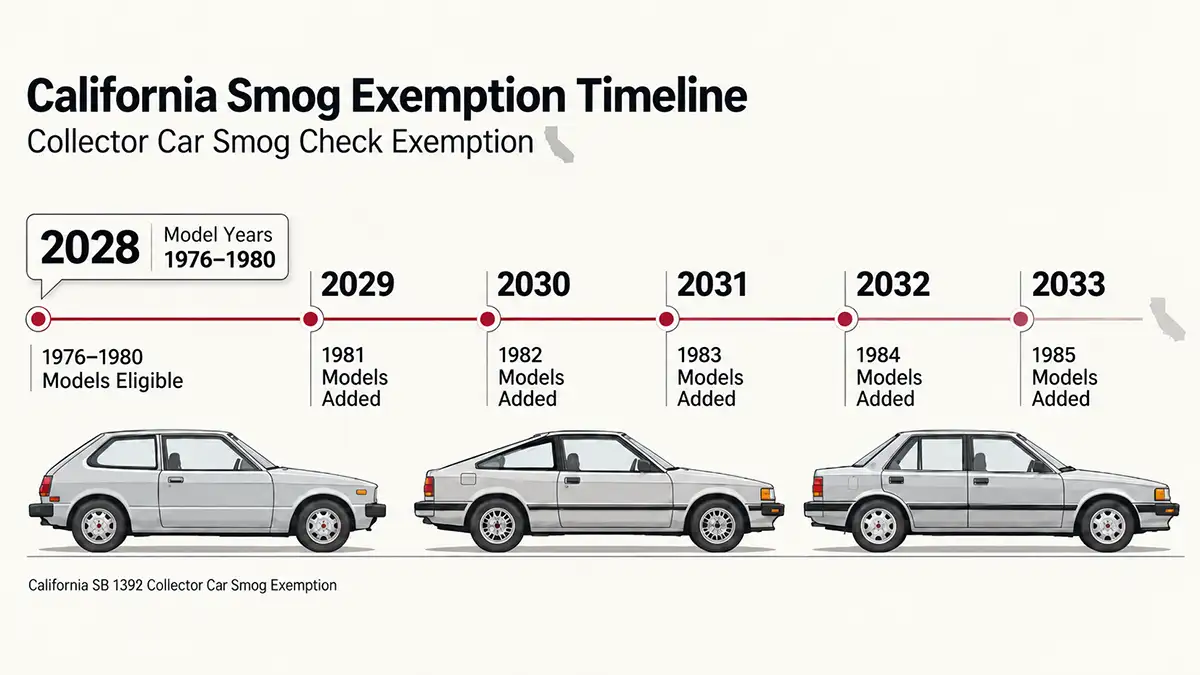
Starting January 1, 2028: Qualifying vehicles from 1976 through 1980 can become exempt.
After that, one additional model year is added each year:
- 2029: 1981 models
- 2030: 1982 models
- 2031: 1983 models
- 2032: 1984 models
- 2033: 1985 models
So, for example, a qualifying 1979 Honda Accord could become eligible in 2028, while a qualifying 1985 CRX Si would have to wait until 2033.
Until your Honda reaches its eligibility year and meets the requirements, its current Smog Check rules still apply.
Which Classic Hondas Can Qualify?
Being built between 1976 and 1985 is only part of the equation.
A Honda must meet California’s definition of a “collector motor vehicle” and be used mainly for collector activities rather than as primary transportation. The law also establishes specific qualifications for exemption eligibility:
- Vehicle age: The Honda must be at least 35 model years old and fall within the exemption schedule established by Leno’s Law.
- Collector vehicle insurance: Beginning in 2028, owners can qualify through this pathway by submitting proof of collector vehicle insurance to the Bureau of Automotive Repair (BAR).
- Limited annual mileage: Beginning in 2030, eligible vehicles driven fewer than 1,000 miles per calendar year can qualify through a mileage verification process developed by the BAR.
- Documentation and verification: Owners must satisfy BAR’s qualification procedures, including submitting insurance documentation, verifying mileage, and paying applicable administrative fees.
California also recognizes historical and special-interest vehicles, but those classifications alone do not guarantee eligibility for the new Smog Check exemption.
BAR is still developing the implementation process for SB 1392, so owners should follow the agency’s updates rather than assume an older Honda is automatically exempt.
Honda Icons From 1976 to 1985
The years covered by the California classic car smog exemption happen to include a fun stretch of Honda history. The Accord was still new to America, the Prelude was arriving as Honda’s sporty coupe, and the Civic family was starting to branch out in ways enthusiasts still remember today.
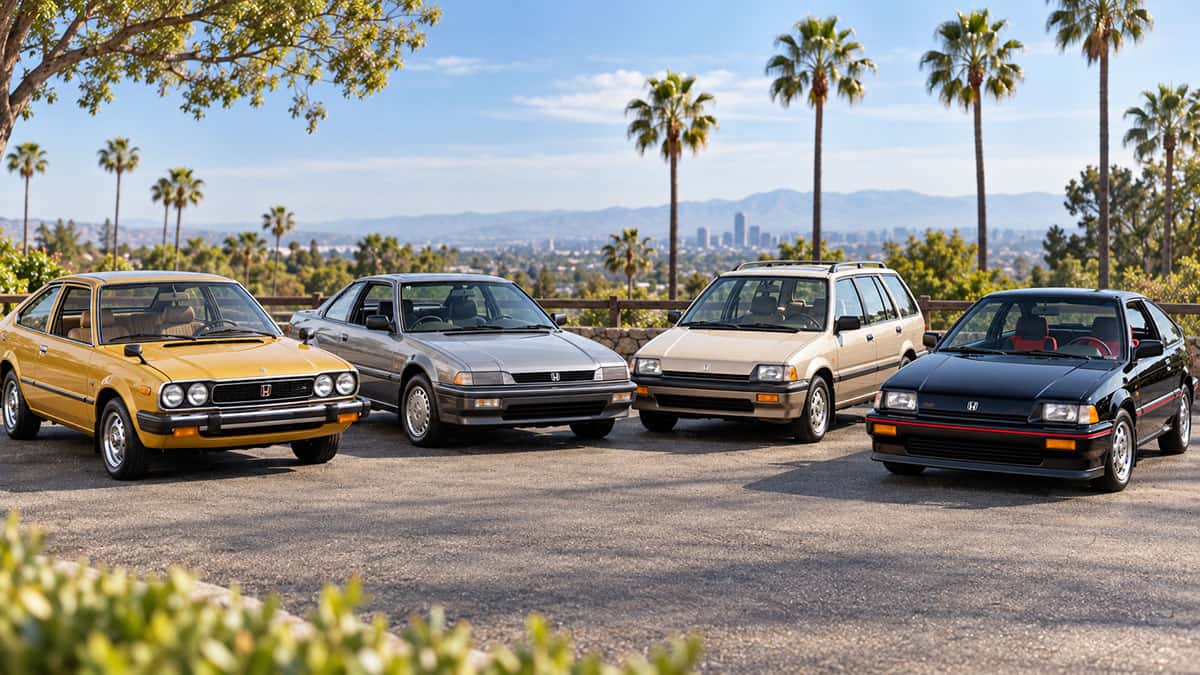
Here are four Hondas from the Leno’s Law years that deserve a closer look.
-
1979 Honda Accord CVCC Hatchback
The Accord first came to the U.S. as a hatchback in 1976, long before it became the midsize sedan most drivers know today. By 1979, Honda added a sedan, but the hatchback still captures the original Accord’s simple, compact character.
-
1983 Honda Prelude
The second-generation Prelude arrived in 1983 with a low coupe shape and pop-up headlights that set it apart from Honda’s more practical models.
Honda’s U.S. specifications show a 100-horsepower four-cylinder engine, seating for four, and a five-speed manual transmission, with a four-speed automatic also available. For more on how the Prelude has evolved over the decades, look at the Prelude’s history.
-
1984 Honda Civic Wagon
Not every collectible Honda has to be a coupe. The 1984 Civic Wagon represents the practical side of Honda’s history, and Honda itself preserves an example in the American Honda Collection Hall alongside cars like the Prelude and CRX Si.
-
1985 Honda CRX Si
If one car on this list speaks directly to Honda enthusiasts, it is probably the CRX Si.
According to Honda’s historical specifications, Honda introduced the CRX Si to the U.S. in 1985 with a 1.5-liter, fuel-injected engine producing 91 horsepower. It was small, light, and focused on the kind of simple driving experience that helped build the Si name into what it is today. A qualifying 1985 example would be part of the final model-year group added to the new exemption in 2033.
What the New Exemption Does Not Change
A Smog Check exemption is not the same thing as permission to make any modification you want.
Engine swaps, emissions equipment, and other modifications can still be subject to separate California and federal rules. If you are looking at a modified classic Honda, it is worth checking the paperwork and applicable BAR engine change requirements before assuming “smog exempt” means every modification is legal.
The same goes for the car’s condition. The California collector car smog exemption tells you whether a qualifying vehicle may be exempt from Smog Check. It does not tell you whether a 40-year-old Honda needs mechanical work, replacement parts, or a proper inspection before you buy it. For parts-related questions, you can contact Pacific Honda’s parts department.
What This Means for Honda Owners in San Diego
Leno’s Law California is still a few years away from taking effect, but it’s worth paying attention to if you own or are considering buying or keeping a classic Honda in San Diego.
Pacific Honda has served San Diego drivers for decades, and the dealership continues to support Honda owners through sales, service, and parts. For anyone with an older Honda from the 1976 to 1985 window, the biggest thing right now is understanding when the new exemption begins and what the car will need to qualify.
As BAR finalizes the process, Pacific Honda’s service department can remain a local resource for Honda owners who need help with parts, maintenance, or questions about their vehicle, while BAR remains the source for the exemption itself.
Have questions about maintaining your Honda? Contact Pacific Honda for assistance.
FAQs About Leno’s Law in California and Classic Hondas
Does Leno’s Law California apply to every classic Honda?
No. The exemption applies only to qualifying collector vehicles from model years 1976 through 1985. Owners must meet the applicable eligibility requirements, including collector vehicle insurance or the limited-mileage qualification pathway.
Does Leno’s Law change the exemption for a 1975 Honda?
No. Gasoline vehicles from model year 1975 and earlier already qualify for California’s existing
Smog Check exemption. That exemption does not depend on the new collector vehicle
schedule.
Will a 1986 Honda become exempt when it gets older?
Not under Leno’s Law. The exemption schedule ends in 2033 with qualifying 1985 model-year vehicles. It does not automatically expand to include newer model years as they age.
Is a 1985 CRX Si the same as a 1986 Civic Si Hatchback?
No. Honda introduced the CRX Si in the U.S. for 1985 and added a separate Civic Si hatchback for 1986. That model year difference matters because the new schedule ends with 1985 vehicles.
Does the new exemption apply when a collector Honda changes owners?
The law provides exemptions for qualifying collector vehicles at initial registration, registration renewal, and ownership transfer. You still must meet the applicable year and qualification requirements, so a sale does not automatically make an older Honda exempt.
Where can I find the application requirements?
Check the Bureau of Automotive Repair for implementation updates. As of October 13, 2026, BAR has announced an October 22 workshop to discuss the qualification process; do not assume that final application forms and procedures are already available.
How do I apply for a Leno’s Law California Smog Check exemption?
The Bureau of Automotive Repair is developing the application and verification procedures. Owners should consult BAR for official instructions as the first exemptions approach in 2028.
Information Current as of October 2026: California’s Smog Check exemption requirements and implementation procedures may change. For the latest eligibility information and official guidance, consult the California Bureau of Automotive Repair.
0 comment(s) so far on Leno’s Law in California: What Classic Honda Owners Need to Know